The Deck

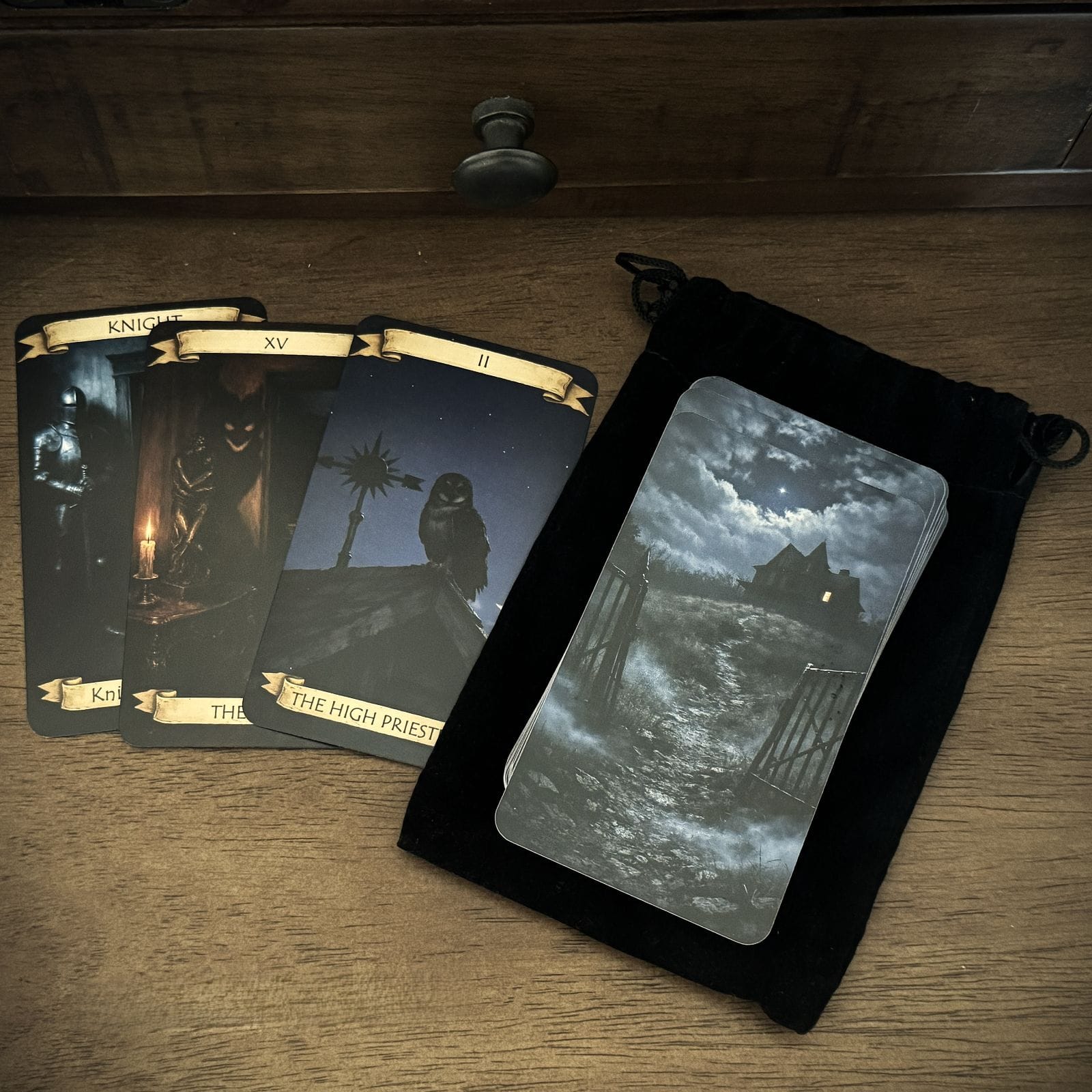
Introduction
The Haunted House Tarot was created to translate the full symbolic grammar of the traditional Tarot into the architecture, atmosphere, and psychological logic of the haunted house.
The effort behind this deck was intended to honor the lineage of tarot symbolism, to maintain fidelity to its kabbalistic pathways, and to enhance those pathways by giving them spatial form. The entire mansion becomes a living diagram of spiritual movement, psychological inquiry, and narrative revelation.
Rather than inventing new meanings or discarding established correspondences, this deck preserves the classical structure (Major Arcana, Minor Arcana, elemental suits, numerology, and the underlying kabbalistic pathways) and re-expresses them through the rooms, thresholds, inhabitants, and phenomena of the old dark house genre. The House becomes a symbolic body: an inner architecture where consciousness flickers like a candle in an upstairs window, where intuition moves through dark passageways, where secrets hide behind locked doors, and forces wait in the shadows in the basement below. Every card began with the traditional meaning first. Only after the core symbolism was firmly anchored did the haunted house metaphor take shape around it. This ensures that each image is not just decoration but correspondence and an architectural analogue to the original esoteric interpretation of the Tarot. The House is not just a setting; it is a map of the psyche, a diagram of ascent and descent, a structure through which the reader travels and explores.
Like other Tarot decks, the images may also evoke personal meanings.
Each deck comes with a booklet that provides concise upright and inverted meanings for all 78 cards, along with the architectural logic that shaped them. It is meant as a companion for readers who wish to explore the haunted house not merely as a place of mystery, but as a structure of meaning, one that invites you to walk its halls, open its doors, descend its staircases, and discover what waits in dark rooms behind locked doors.
The Blueprint
This deck is not a random collection of haunted imagery. It is a house built on a blueprint; the same architecture that underlies the Hermetic Tree of Life.
The numbered cards correspond to the ten Sephiroth: the states of being, the rooms of consciousness, the chambers where experience gathers and transforms. Each pip card occupies a certain room in the house, a place where a particular kind of emotional or spiritual work occurs. These Sephiroth are not abstract ideas here. They are rooms you can walk into.
The Major Arcana follow the 22 Paths that connect those rooms. In the Tree of Life, the Paths are the transitions, the movements, the thresholds between states. In this deck, they are the corridors, staircases, gates, and hidden passages that carry you from one emotional chamber to another.
This structure gives the deck its internal logic. The pips show where you are. The Majors show how you move. The Sephiroth are the rooms you inhabit, each with its own atmosphere, history, and emotional weight. The Paths are the hallways you walk, the choices you make, the fears you face, and the insights that guide you. When you read this deck, you are not just interpreting images. You are navigating a symbolic house built on one of the oldest maps of human experience.
How This Deck Was Made
The deck, guidebook, and website are the result of a deliberate creative process. Every card was conceived, designed, and refined with specific symbolism, narrative intent, and emotional architecture. Artificial intelligence was used as a rendering tool to assist in producing the visual artwork, but the concepts, compositions, themes, and interpretations are original creative work. The images were not generated randomly; they were directed, curated, and shaped to express the meaning of each card and the structure of the deck as a whole.
Many cards went through dozens of iterations. Details were refined, lighting adjusted, objects added or removed, and scenes reshaped until they matched the intended meaning. The goal was consistency: a deck that feels like it comes from one story, one world. Technology helped bring the rooms to life, but the design came from deliberate choices about what each card should say and how it should feel.
This deck is not AI art. It is human intention expressed through a modern tool.
This deck was created with care, intention, and respect for the traditions of Tarot and the evolving tools of modern creativity. The rights to the artwork and text remain with the creator, regardless of the technologies used in the production process. Please honor the work by treating it as you would any handcrafted artistic creation: with respect for the craft, the effort, and the imagination behind it.